Used by the insurance industry for decades, catastrophe (cat) modeling is now attracting increasing interest from other sectors. Fathom’s Dr Matthew Jones provides an introduction to catastrophe models – what they do, what they’re made of and how to integrate them into your business.
A catastrophe model is a complex computational tool used to quantify the potential financial impact of an extreme event, such as flood, earthquake or wildfire, on an organization’s assets. Since the 1980s, they have been used extensively by the (re)insurance industry to assess and manage risk.
However, climate change and growing exposure due to population movement, economic growth and urbanization have shifted the risk landscape in recent years. The behavior of extreme events has changed, making them more frequent, severe – and costly. This means catastrophe models are in increasing demand, not only by insurers, but by capital markets, asset managers, consultants, governments and any organization that needs to understand, manage and quantify risk.
What is flood catastrophe modeling?
A flood catastrophe model calculates the behavior of a set of extreme flooding events by assessing their severity, location, frequency and other characteristics, under a range of scenarios, including climate.
It works by simulating millions of stochastic, or random, events over a long period – in the case of Fathom’s Global Flood Cat model, 10 million events over 10,000 years.
This determines the probability of the event happening, as well as assessing the spatial correlation. In other words, it tells us the probability of one location flooding at the same time as another during the event, and to what extent each location will be impacted.
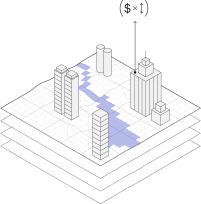
The model also assesses an organization’s exposure, i.e. how many of its assets such as houses, commercial or industrial buildings are at risk of flood, and estimates the potential financial loss, either aggregated across portfolios or for individual locations.
This combination of an event-based methodology with a way of estimating financial loss means that models can be used to understand just how bad events can get and how diversified a portfolio of assets is.
How do catastrophe models work?
Fathom’s Global Flood Cat model is built on a framework consisting of five components:
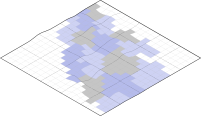
Event set
Spatial extent of events
- Characterized by size, location and return period of flooding per grid cell.
- Millions of events representing 10,000 years of activity.
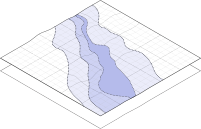
Hazard
Physical intensity for each location for each event
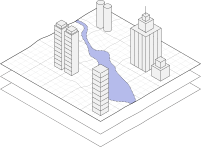
Exposure
Global asset value distribution
Vulnerability
Relating hazard to damage per asset type
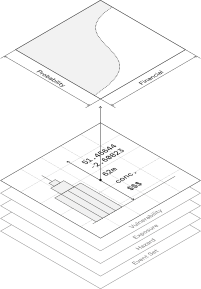
Financial module
Calculating a range of loss metrics for different financial perspectives
- Characterized by size, location and return period of flooding per grid cell.
- Millions of events representing 10,000 years of activity.
Flood hazard maps vs catastrophe models
At this stage you might be wondering, “Can’t we just use flood maps for the same purposes?” Catastrophe models work differently to flood maps and have different uses:
Hazard maps determine the probability of a hazard occurring at a specific location and to what extent (i.e. depth). They tell us which locations are at risk of flooding individually. They do not tell us which locations will flood at the same time as others during an event and nor do they provide any method for the quantification of that risk. For that you need an event map.
Catastrophe models can be thought of as a huge collection of flood event maps. They tell us whether Location A will flood at the same time as Location B, and they offer metrics to quantify the risk financially. However, catastrophe models are rarely able to provide a full context and broader visualization to their output. Users can only get this by using a hazard map alongside catastrophe model results.
Another crucial difference is that catastrophe models translate from flood depth to financial loss for the specific set of assets entered into the model, meaning that they offer a more dynamic risk perspective; clients can input a range of information on their assets to generate a wide variety of outputs.
Learn more about Fathom’s approach to catastrophe modeling >
Inputs to catastrophe models
To run a catastrophe model, the user inputs details of the assets they want to assess, including the location, value and other information (e.g. type of property, building height, etc). This could be for individual assets or entire portfolios.
Outputs of catastrophe models
The model outputs a range of metrics, including a loss for each event, an average annual loss (AAL) and exceedance probability (EP) curves – the probability of losses exceeding a certain amount.
Because the model contains events, it allows the user to answer questions such as: “What is the chance of the largest event in any year exceeding $1bn?” and “How much capital do I need in order to have less than a 0.5% chance of going out of business next year?”
What are catastrophe models used for?
Cat models were originally designed for insurers and today they are an integral part of the re/insurance business. They are used to estimate the potential damage and insured loss caused by hazards, informing decisions on everything from risk tolerance and transfer to pricing, underwriting, planning and setting financial reserves.
But they are not used exclusively by insurers. Capital markets use cat modeling to price catastrophe bonds; governments have used them for disaster management and response planning; and, increasingly, organizations ranging from banks to asset managers and real estate developers are looking at cat models as a way to assess, manage and quantify physical climate risk. Uses include:
Asset risk management
Understanding and quantifying the risk to assets and investments, with metrics such as average annual loss (AAL) and exceedance probability.
Pre-investment due diligence
Asset managers can use cat models to ensure long-term investments are resilient to current and future flood risk.
Real estate analysis
A standardized approach across regions is particularly useful for assessing global real estate investments.
Regulatory compliance
Detailed reporting on physical climate risks for assets, in line with ever-evolving regulatory requirements.
Climate risk consulting
Flood catastrophe model data can help consultants provide detailed and actionable insights to their clients.
Climate stress testing
By simulating future climate impacts, firms can better prepare for the potential impact to their assets and business operations. Cat models provide a more detailed and comprehensive understanding of impacts than hazard maps alone.
Portfolio diversification management
Risk Managers use cat models to assess overall flood risk, taking into account the effect of geographical spread and correlation of risks.

Explore the rise of catastrophe model usage in banking
Catastrophe risk exposure for banks is increasing as the world becomes warmer and more volatile. The traditional safety net offered by insurers is starting to buckle under the weight of extreme weather events too. Climate Proof interviewed leaders in six G-SIBs about their adoption of cat models in banking in response to this threat. Download the report to learn more.
How to access catastrophe models
There are a number of ways to access catastrophe models, depending on your requirements and in-house capabilities.
Cat modeling software
The most common way to access cat models is via a cat modeling software platform. The open-source Oasis framework incorporates a set of data standards, an API for uploading exposure data and running cat models and a toolkit for developers and model builders. Global Flood Cat is fully Oasis-enabled and available through a range of cat modeling software platforms including the Nasdaq Risk Modelling for Catastrophes and Moody’s RMS Intelligent Risk Platform.
In-house direct consumption
If your organization has the requisite skills, technology and capacity, a catastrophe model can be hosted in-house. This allows you to customize the model further to fit your own business processes and view of risk.
Cat model data outputs as a service
Most organizations don’t have the capability to host cat models in-house. In this case we can provide processed flood risk data based on geographical locations and asset details supplied by the client. This allows them to access critical risk information without needing technical expertise, resources or infrastructure.
Want to learn more about catastrophe modeling?

Watch the product briefing
Fathom’s Catastrophe Model Product Manager, Olivia Sloan, lead a short product briefing on Fathom’s new Global Flood Cat. Providing a concise overview of the catastrophe models, how Global Flood Cat was built, and use cases for catastrophe models in financial markets.
Read the book
Fathom’s Chief Product Officer, Dr Matthew Jones, co-authored a comprehensive guide to natural catastrophe risk modeling – ‘Natural Catastrophe Risk Management and Modelling: A Practitioner’s Guide’. The introductory chapter provides an excellent introduction to catastrophe modeling and a glossary of terms for the industry.
For more detailed information on flood cat modeling, take a look at Fathom’s Global Flood Cat model, read our white papers and insights and delve into our research into this evolving and expanding field.
Related research

A climate conditioned catastrophe risk model for UK flooding
New research from Bates et al. describes the creation of a transparent flood model for the UK that simulates pluvial, fluvial and coastal flood risks for 10 different return periods.

A 30 m global flood inundation model for any climate scenario
New techniques to simulate the behaviour of floods, which are then validated against a series of benchmarks to reveal unprecedented levels of model fidelity.

A 30 m global map of elevation with forests and buildings removed
This work signifies one of the biggest step-changes in global flood modelling capabilities since the advent of the field.