Japan Flood Map
A Japan Flood Map that offers climate-conditioned flood hazard modeling for the whole of Japan
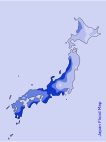

Fathom’s Japan Flood Map offers a comprehensive and consistent view of flood risk across Japan. It represents fluvial (river) flooding, covering every river in the country, as well as pluvial (flash) and coastal flooding.
It projects changes in hazard across multiple different climate scenarios to provide organizations with actionable insights into flood risk in Japan, both now and into the future.
Based on Fathom’s award-winning Global Flood Map, the Japan Flood Map combines world-leading research and cutting-edge modeling techniques with high-quality terrain data. It enables you to critically assess the impact of flood risk in Japan against any portfolio, book of business or asset.
Flood risk data and hazard modeling for Japan
Japan’s flood risk
Flooding is one of the most significant natural hazards in Japan. The country is prone to extreme rainfall and this is becoming more frequent as global temperatures rise.
Japan’s vulnerability is largely caused by its topography and location. It is an archipelago with 18,486 miles (29,750km) miles of coastline – the sixth longest coastline in the world – and has a large and complex network of rivers, many of which are short and fast-running as they flow down steep mountainsides directly into the sea.
As an island nation in the path of frequent Pacific storms, Japan experienced an average of 25 typhoons each year between 1990 and 2020, many of which struck the mainland. The subsequent flood hazard and its impact on critical infrastructure and industry mean a strategic approach is crucial to maintaining national economic security and community safety.
Fathom’s Japan Flood Map shows flood depth and extent for multiple return periods and climate scenarios, and covers pluvial, fluvial and coastal flood. This gives planners and risk managers a consistent, comprehensive view of both present and future flood risk to Japan’s communities, businesses, assets and critical infrastructure.
Use cases for Japan flood risk map
Fathom’s Japan Flood Map is used by a diverse range of sectors to translate physical hazard into actionable business intelligence.
Insurance underwriting and pricing: Fathom works with major (re)insurers, including Sompo International, a subsidiary of Tokyo-based Sompo Holdings. Insurers and reinsurers use the data to:
- assess flood risk at individual properties and locations
- support underwriting and pricing decisions
- manage accumulation risk across portfolios
Find out how Fathom worked with the global property and casualty insurer Sompo International in our case study
Engineering and infrastructure: Engineering consultancies, infrastructure operators and asset owners use the map to screen sites for flood risk during planning and design. It enables resilience assessments of critical infrastructure, helping identify vulnerable assets and prioritise investment before more detailed site investigations begin, and supports defense planning.
Banking and financial risk: Japan’s banks, investors and other financial institutions use Fathom’s data to assess the climate resilience of property and infrastructure portfolios. It supports climate risk reporting, stress testing and portfolio analysis by identifying assets exposed to current and future flood risk.
Real estate due diligence: Property developers, real estate investors and asset managers use the maps to incorporate flood risk into investment and development decisions, helping ensure new projects remain resilient under both today’s climate and future flood scenarios.
Public sector planning: National and local government bodies use the data to support flood risk assessments, emergency planning, infrastructure investment and long-term climate adaptation, particularly where consistent, high-resolution flood information is needed across large geographic areas.
Tokyo flood tunnels: Mitigating and adapting to flood risk in Japan
Tokyo is among the world’s most populous and economically important metropolitan areas. It is also highly vulnerable to flooding from typhoons and intense rainfall, and is built on the floodplains of several major rivers such as Tonegawa, Edogawa and Arakawa.
Rapid urbanization and suburban development have added to the exposure by putting more people, property and critical infrastructure in harm’s way.
However, Japan provides valuable lessons for both public and private sectors in how to effectively mitigate and adapt to flood risk.
An example of this is Tokyo’s Metropolitan Area Outer Underground Discharge Channel (MAOUDC, also known as G-Cans). Located almost 40km north of Tokyo, the MAOUDC protects the city from flooding by collecting floodwater through a series of intake structures, and carrying it through a 6.3 km-long tunnel. The flow is then regulated in a huge underground storage chamber before the water is pumped safely into the Edo River.
Completed in 2006, it is the result of co-ordinated planning across national, prefectural, and municipal bodies. Key to the project was a thorough cost-benefit analysis to assess long-term value and to understand construction and maintenance costs.
While it cost roughly 230bn yen (US$2.6bn) to build, it has significantly reduced flood risk in Tokyo. Flood-affected households in the region declined from more than 84,000 in the 1980s to approximately 5,745 in the 2000s and, by 2024, it is estimated to have prevented 148.4 billion yen ($940.3m) in flood damage.

Future flood map Japan
Fathom’s Japan Flood Map provides projections for present-day flood risk (2020) and any projected combination of future year and plausible climate scenario up to 2100.
Fathom’s Japan flood map uses our Climate Dynamics framework to allow you to fully customize your view of risk under different climate scenarios and warming levels using IPCC pathways (SSPs, RCPs) or NGFS frameworks.
Japan data powered by Global Flood Map
Fathom’s Japan Flood Map is a subset of Fathom’s award-winning Global Flood Map – the first global flood map to provide risk professionals with all flood perils and climate options.
Key features of Fathom’s Japan Flood Map:
Based on FABDEM+
Fathom’s ~30 meter resolution terrain dataset is supplemented with high-quality LiDAR data to provide an accurate picture of the Earth’s surface.
A view of future flood risk
Fathom’s climate-conditioned hazard data for Japan provides a view of risk for any projected combination of climate scenario and future up to the year 2100.
Inland and coastal flooding
Understand risk from all major types of flood that affects Japan – fluvial, pluvial and coastal – with both defended and undefended views.
Access and scale
Instant on-demand access to Fathom’s data via API, portal, direct provision or via a range of platform partners. You can license the entire country or specific regions, or target high-risk areas down to a localized polygon.
Metadata for an extra level of transparency
Fathom provides an added layer of information, enabling you to understand how influencing factors in input data may affect the certainty of flood risk.
Available as depths and Risk Scores
Japan flood maps are available as both flood depths and Risk Scores, which deliver a quick and consistent way to assess and compare risks.
Quote Fathom provided a first-rate product and service based upon cutting-edge research and methodologies, which are both robust and transparent. Their flood data sets are global, consistent and high calibre. Most importantly, Fathom is a responsive and collaborative firm who consistently deliver.

Quote Fathom provide a first-rate product and service based upon cutting-edge research and methodologies, which are both robust and transparent. Their flood data sets are global, consistent and high calibre. Most importantly, Fathom is a responsive and collaborative firm who consistently deliver.

Quote
“Fathom’s data are super granular, which is something that our customers value a lot. You need that granularity to really understand how a flood will impact an asset.”

How to access Fathom’s Japan Flood Map
Fathom API

Self serving, seamless data provision using Fathom’s cloud-based API. By using the API, Fathom’s users have sub-second on-demand access to the entire Japan Flood Map.
Fathom Portal

If you do not have an in-house platform solution, Fathom’s portal offers an interactive platform by which users can host, view and analyze data.
To trial the platform using Fathom sample data for free, request sample data.
Direct Provision

If you would prefer to host the data on-site, Fathom can provide GeoTIFF files that can be integrated into your internal systems and data viewers.
Partners

Fathom data are available through a range of partners, including via Swiss Re’s CatNet platform – an advanced location intelligence tool – and Swiss Re’s Risk Data & Services solutions.

Tailored to your territory
One of the main advantages of using data from Fathom’s Global Flood Map is that it eliminates the need to patch together multiple datasets. There is one methodology, one format and one source of truth – for exactly the area you need.
From global insurance portfolios to municipal urban planning, you only pay for the coverage you require. Alongside our Japan map, you can license the entire planet, specific regions, or target high-risk areas down to a localized polygon.