Climate Dynamics Framework
A flexible tool that enables Fathom’s flood models to represent any projected combination of future year and climate scenario up to 2100.

Climate Dynamics is Fathom’s solution for modeling how flood risk changes over time and under various climate scenarios. Incorporated into Fathom’s global flood catastrophe model, flood maps and risk scores, the framework delivers a globally consistent view of the impact of climate change on flooding. Climate Dynamics represents a major innovation in flood modeling, allowing businesses to assess flood risk under any plausible future up to 2100.
Shape your view of flood risk under any future scenario
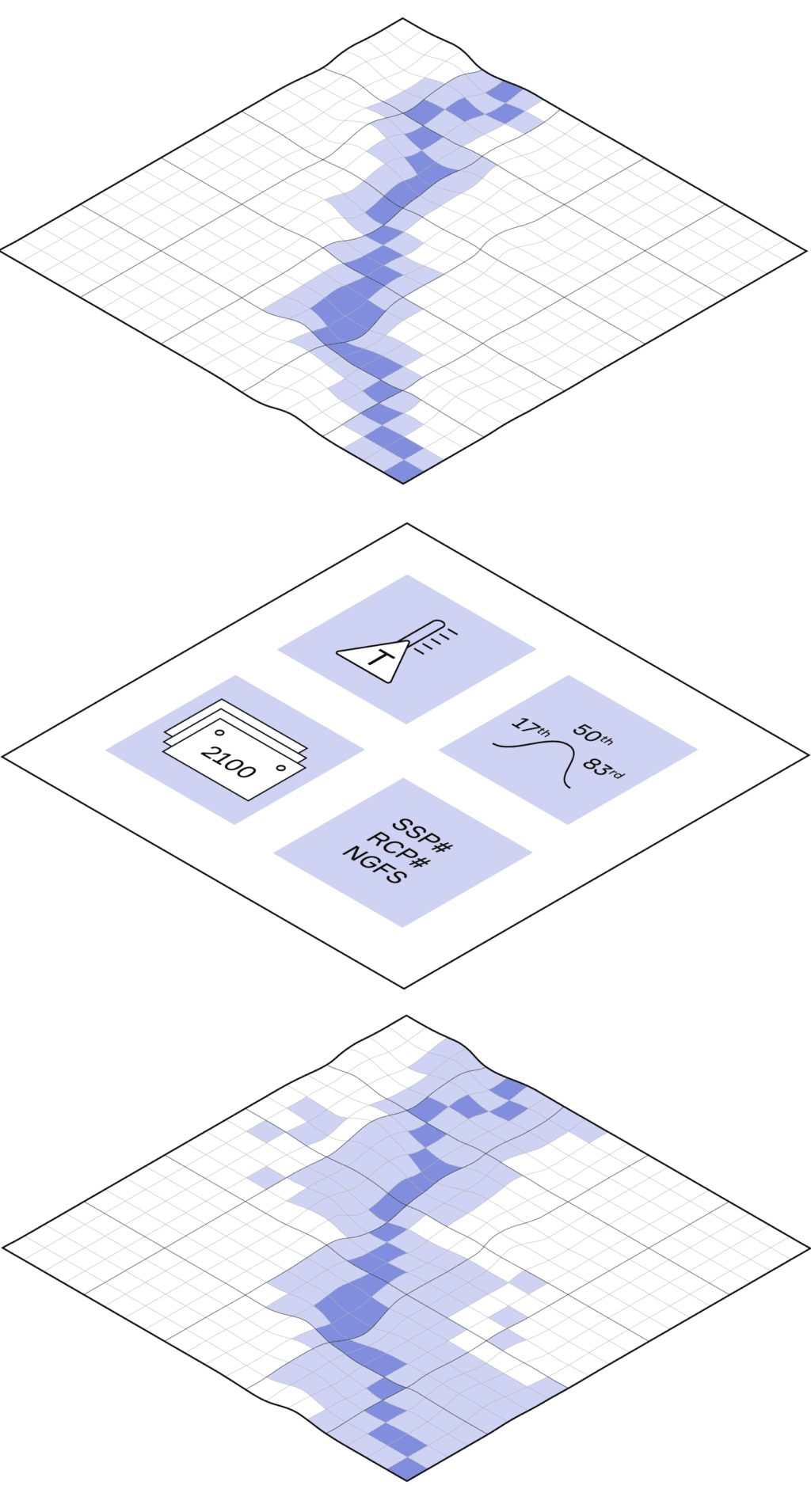
The Climate Dynamics framework is fully customizable and integrates outputs from climate, hydrological and sea level models with our existing flood hazard models through the use of change factors. The result is climate-adjusted, multi-peril flood models that represent all plausible scenarios, from the optimistic to the most catastrophic.
It enables you to effectively respond to global regulations such as TCFD (G20), CSRD (EU), SEC Climate Rule (US) and the HKEX ESG Reporting Guide (Hong Kong). It represents plausible future flood scenarios, providing data for pluvial, fluvial and coastal flooding. Crucially, Climate Dynamics provides local precision that can be applied on a global scale.
Fathom’s Climate Dynamics framework is a flexible tool, allowing users to interrogate assumptions and develop a customized view of risk. It can reflect low-emission pathways that are characterized by minimal, manageable increases in climate, or high-emission pathways where future projections capture larger changes in extreme events and hydrological responses. It provides a globally consistent projection of how climate and flooding may evolve, with flexibility to adapt to diverse business needs.
Customize your view of flood risk using Climate Dynamics
Climate Dynamics is not a standalone product but an enhancement to our market-leading flood model offering. It is fully integrated across Fathom’s product portfolio of scores, maps and models.
Using Climate Dynamics you can fully customize your view of risk under different time horizons, climate scenarios and warming levels, within realistic combinations.
You have the option to choose from Fathom’s predefined climate options or select from the following:
Choose any year up to 2100.
Select warming levels from 1°C to 5°C above pre-industrial temperatures.
Tailor scenarios using IPCC pathways (SSPs, RCPs) or NGFS frameworks.
Median (50th percentile): Central estimate of flood risk.
Likely range (17th-83rd percentiles): IPCC-defined range for possible outcomes.
Key features
Multi-model inputs
We’ve used data from multiple global climate, hydrological and sea level models to help understand how variables like extreme precipitation, peak flow and sea level may change over time under different levels of warming, and what the uncertainty in those projected changes are across different models.
Transparent
Explicitly represented model uncertainty for the three perils by providing the median and likely range of outcomes based on the IPCC’s definition. Offering full transparency so you can interrogate and understand certain modeling assumptions to deliver your own view of risk.
Customizable
To account for the inevitable multi-layered uncertainties associated with projecting future climate, Fathom has designed its climate change capabilities to be as flexible as possible. Given that we cannot predict what future emissions pathway we will follow, the Climate Dynamics framework allows users to address this uncertainty by looking at all ends of the spectrum.
With flexibility and customization – under different time horizons, climate scenarios and warming levels – risk professionals across sectors can use this tool to build their own view of risk, aligned with business needs.
Change-factor approach
A change-factor approach (relative change in a variable, per degree of warming) lies at the heart of the framework, allowing us to combine high-resolution flood maps with future climate projections. Through the use of outputs from multiple climate, hydrological and sea level models, we increase confidence in our future projections.
Watch our webinar below, where Fathom’s Principal Climate Scientist Dr Natalie Lord explains how this was done.
Geographical granularity applied globally
Integration within our Global Flood Map, Global Flood Cat and Risk Scores mean a flexible climate framework for the whole world.
How Climate Dynamics framework supercharges our flood maps
Climate Dynamics considers future changes in extreme rainfall, river discharge and sea level, and incorporates these impacts into our flood and catastrophe models. A full range of scenarios is available in our Global Flood Cat, Global Flood Map and US Flood Map. A more limited set of scenarios applies to our UK and Japan Flood maps.
Climate Dynamics allows the assessment of flood risks for any peril and any plausible climate scenario, anywhere in the world. This allows you to tailor it specifically to your requirements and use case.

Explore the making of Fathom Climate Dynamics framework
Fathom’s team of scientists will present, in detail, this groundbreaking new framework. We will explain the motivation behind our work in climate change modeling and the development of Climate Dynamics: The science, research and methodology underpinning it, and how it varies for each peril.

Representing climate uncertainty
Risk models need to reflect multiple emission and climate scenarios to show how flood risk may change in the future. They also need to deliver this on both a global and country-by-country basis. Climate Dynamics enables you to do just this, modeling flood risk based on various global warming levels (based on specific temperature increases, such as the Paris Agreement targets of 1.5°C or 2°C) and emission scenarios, including:
- SSPs (shared socioeconomic pathways): The latest scenarios from the IPCC, which combine climate projections with different socioeconomic futures.
- RCPs (representative concentration pathways): The previous generation of IPCC scenarios.
- NGFS (Network for Greening the Financial System): Scenarios tailored for financial institutions and regulators to conduct climate stress tests.
There is no “right” answer as to which scenario you should choose; this will depend on the use case such as the specific regulatory compliance requirements, or your appetite for risk.
It’s worth noting that there is a general move away from the most extreme, high-emission scenarios, since already-implemented or planned climate policies help push us towards the more moderate warming scenarios, but these high-emission scenarios could still be of interest. Either way, by selecting both a lower-warming and a higher-warming scenario, you can better understand the range of potential future risks and account for uncertainty in emissions and climate policy.