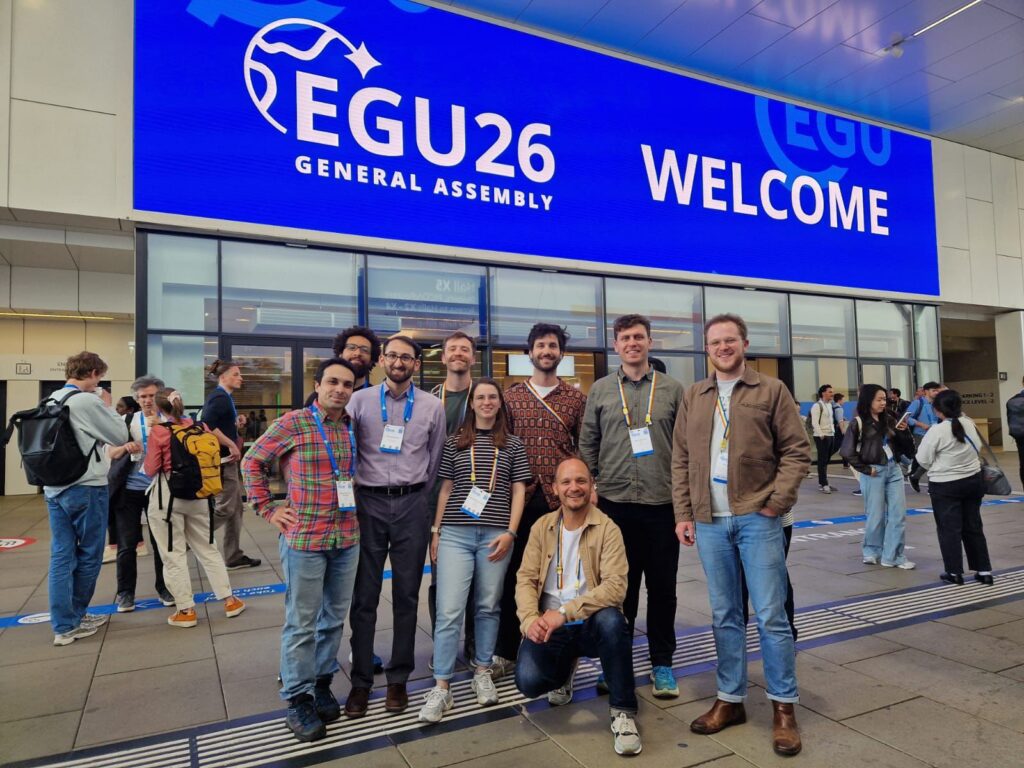

Every year, members of Fathom’s science team make their way to Vienna, Austria, to attend the European Geosciences Union (EGU) General Assembly, Europe’s largest geoscience event.
It brings together scientists from around the world, more than 20,000 delegates from 125 countries attended this year’s event to find out what fellow scientists are working on, to check the direction of progress in and to contribute to the advancement of science by presenting their own research.
Attendees delivered presentations and posters at 1,014 sessions this year, on subjects ranging from seismology to climate change, hydrology and natural hazard. Fathom’s scientists were among them.
Fathom’s research: Event set generation with AI
Much of the conversation at the conference centred around machine learning (ML) and generative AI, an area that has been gaining huge momentum fuelled by advances in computing power, new tools and technical knowledge. Advanced ML techniques are increasingly being used to develop flood forecasting and early warning systems, to improve datasets and to fill gaps in data availability.
Fathom is a leader in this field, with our ML specialists, hydrologists and climate scientists pooling their knowledge to explore how ML and AI can improve the way we model flooding.
Most of the research our scientists presented at EGU 2026 was related to our ongoing event set generation project. This project aims to improve flood mapping by generating high-resolution weather data using a combination of climate model simulations and generative AI diffusion techniques and validating the output by running it through physics-based models.
This hybrid approach differentiated Fathom’s research from the many other AI projects presented at the conference: instead of just building advanced AI models, we embed them in a full physical modeling chain to test whether they genuinely work for real-world flood risk applications.
The Fathom team’s presentations at the EGU
Dr Chris Lucas, Principal Machine Learning Engineer
The infinite ensemble: Generative AI for catastrophe risk
Chris presented an overview of the Fathom event set generation project, which uses generative AI diffusion models to downscale coarse weather data and generate huge synthetic event datasets – without the huge computational cost. The event datasets are then fed into hydrological models to ensure the events were physically plausible. This system is designed to create 50,000 years of weather data that can be used to create detailed flood maps, helping insurers better understand and manage extreme flood risk.
Read the abstract to learn more.

Dr Nans Addor, Head of Hydroclimate Science
Generating record-breaking floods using a SMILE and climate model emulation: A proof of concept over the UK
In his poster, Nans talked about Fathom’s new AI-based approach to creating long, high-resolution simulations of weather and climate conditions (see overview below), which was demonstrated over the UK.
The AI-generated simulations are converted into river flow using a hydrological model. Testing the results over the UK shows that the approach accurately reproduces historical flood behaviour while also generating plausible extreme events beyond those observed in the historical record.
Read the abstract for more details here.

Dr Alex Marshall, Senior Machine Learning Engineer
Fast emulation of climate models for precipitation and flood impact modelling using autoregressive video diffusion
The flood modeling chain begins with a climate model. A major challenge with estimating the risk of extreme floods is that we need very long climate simulations and running traditional climate models for tens of thousands of years is computationally extremely expensive.
Alex talked about the creation of a lightweight and computationally efficient climate emulator built upon a video diffusion architecture. Tests show the model closely matches the behaviour of the original climate model, and offers a practical way to create thousands of years of physically realistic flood scenarios for risk assessment.
Dive into the abstract to learn more.

Dr Jorge Sebastián Moraga, Senior Climate Scientist
Downscaling precipitation projections using Generative AI: Benchmarking against the WRF dynamical climate model
Seb presented new work comparing Fathom’s generative AI precipitation model with a state-of-the-art, physics-based dynamical climate model.
The study shows that our AI model not only reproduces observed climate well but also closely matches the dynamical model’s projections of future precipitation, particularly for extremes. This suggests the generative approach can provide credible insights into future climate and flood-relevant hazards at a fraction of the computational cost.
Read the abstract here.

Dr Jannis Hoch, Senior Hydrologist
Impact of hydrological model spatial resolution on streamflow estimation and catastrophe model event clustering
Jannis presented his research examining how the resolution of hydrological models affects flood simulations used in catastrophe modeling. Comparing model resolutions from 1 km to 5 km, the researchers found that higher-resolution models generally improve the accuracy of river flow estimates, particularly in upstream catchments. The work helps inform the trade-off between model accuracy and computational efficiency in flood risk assessment.

Dr Simbi Hatchard, Senior Scientific Developer
Do small and large river floods change differently under future climate change?
Climate change is expected to increase heavy rainfall, but changes in soil moisture and snowmelt also influence fluvial (river) flooding and, in some cases, can counterbalance changes in extreme rainfall making it difficult to predict future flood risk. Simbi explores if these variables may differently affect smaller, more frequent floods and larger, rarer floods across Europe and how to reflect this in Fathom’s flood maps.
You can find out about the methodology and results by reading the abstract here.

Dr Irene Benito Lazaro, Senior Coastal Model Developer
Uncovering unprecedented storm surges in European and Mediterranean coastlines
Irene’s presentation was based on her PhD research paper published in Environmental Research, which examines unprecedented storm surges across Europe. She used a 525-year synthetic dataset to simulate events more extreme than anything observed so far to explore how coastal flooding could look beyond the historical record. The work is one of the first large-scale studies of its kind.
You can read the full research paper here.

Read about how Fathom’s advanced global flood maps and catastrophe models are helping flood risk professionals to understand extreme risk and make more informed, real-world decisions.

Flood inundation modeling using the Surface Water Ocean Topography mission
New research presents a model for estimating river channel depth based on data gathered by the Surface Water and Ocean Topography (SWOT) mission.

Quantifying UK coastal flood exposure under future sea-level rise to 2300
How will sea level rise affect flood risk to populations and critical infrastructure in the UK in the next few centuries? A study by the UK Met Office, Bristol University and Fathom has found that the number of people exposed to flood by 2300 could rise dramatically – but global reductions in greenhouse gas emissions could reduce these numbers.


Automated tail-informed threshold selection for extreme coastal sea levels
A new method, TAILS, sharpens how we identify extreme events by focusing on the most critical data, giving clearer, more reliable estimates of future coastal hazards worldwide.

Introducing BURGER, Fathom’s new extreme rainfall dataset
New research by Fathom’s Senior Hydrologist, Dr Jannis Hoch, and other Fathom scientists describes Fathom’s new dataset, Bottom Up Regionalised Global Extreme Rainfall, or BURGER for short. It’s the first of its kind to be created from rainfall gauge data and the first to contain extreme estimates for durations as short as an hour.
