How Fathom uses AI for flood modeling
Using cutting-edge artificial intelligence and machine learning technologies, Fathom has pushed the boundaries of flood modeling and climate intelligence. But it’s a tool that enhances rather than replaces our expertise.
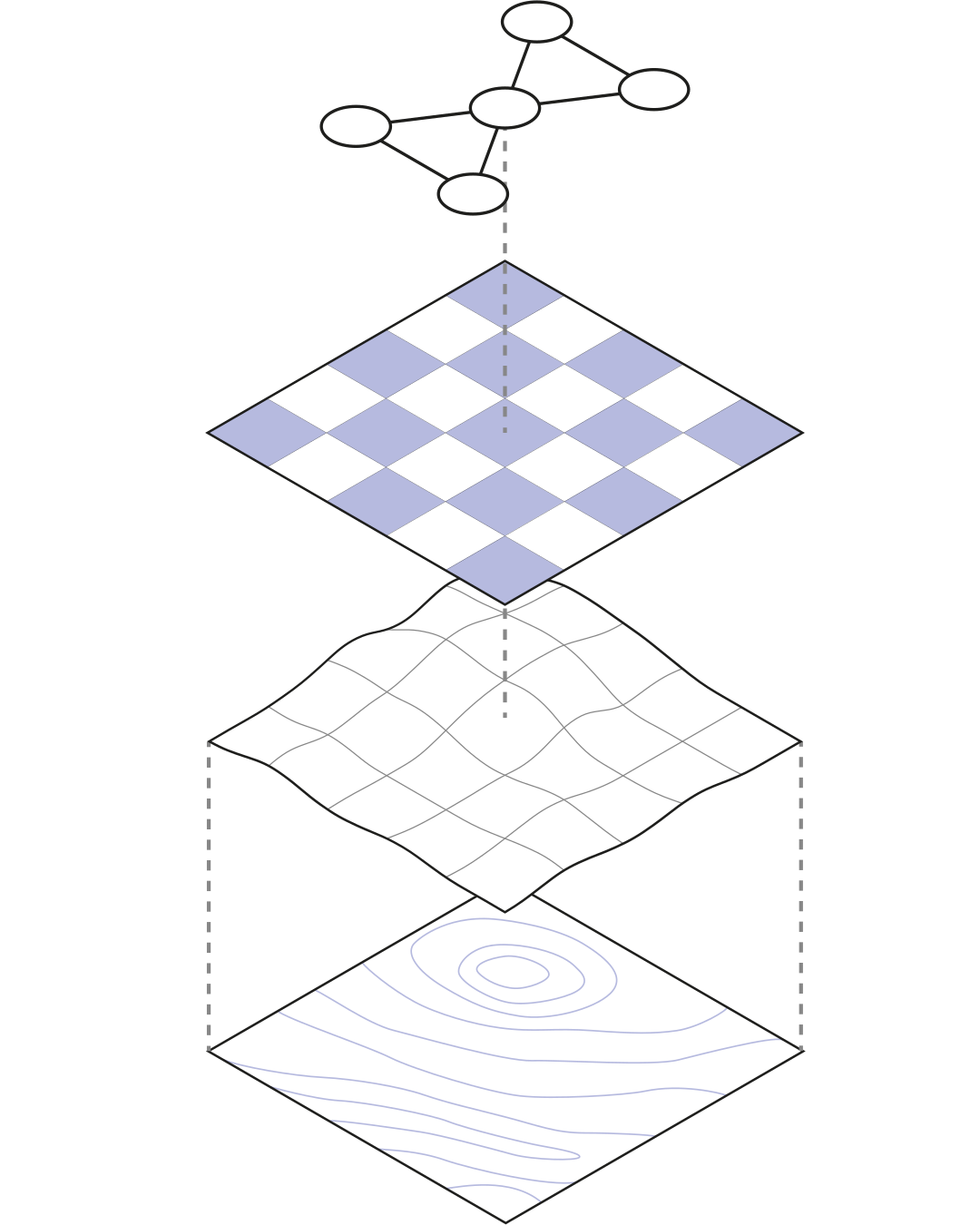

Fathom’s approach to AI
Geospatial AI is developing fast, and its capabilities now mean that it can deliver real benefits to flood modeling. Fathom is a global leader in flood and climate risk, and we believe in using every tool at our disposal to improve the products and services we offer.
Our machine learning experts, Dr Chris Lucas and Dr Alex Marshall, are working alongside Fathom’s world-renowned hydrologists and hydroclimate scientists to conduct ground-breaking research into AI and machine learning techniques – and their real-world industry applications.
The AI and machine learning tools and techniques we use at Fathom are firmly grounded in our scientific expertise. All the AI tools and techniques employed are subject to strict guardrails and principles, and we will always be transparent about how we use it.
How Fathom uses artificial intelligence in flood modeling
Fathom uses innovative artificial intelligence and machine learning techniques across these key areas:
1. Terrain data processing
Cleaning up terrain data to create a bare earth DEM
The quality of a flood model depends largely on the quality of the terrain data. Terrain data feeds into the digital elevation model (DEM), which represents the topography of the Earth’s surface and allows us to model the way the water flows.
However, high-quality terrain data, generated by remote sensing technologies such as LiDAR (light detection and ranging), is not available everywhere in the world and the data available in many other areas is much coarser, prone to systematic errors. They often also include artifacts such as trees and buildings, which can artificially block the flow of water and skew the flood simulation.
Fathom uses a computer vision machine learning technique to transform the best available satellite data to better map the underlying terrain by correcting offsets and stripping out artifacts such as trees and buildings.
The result is our global ‘bare earth’ DEM, which allows us to model the flow of water across a 2D grid and generates a more realistic hazard map.
Creating data consistency with FathomDEM+
Our next-generation global terrain dataset, FathomDEM+, takes AI and machine learning techniques to a new level.
The dataset directly incorporates LiDAR and other high-resolution datasets in regions where they are available. Where they are not available, Fathom used an innovative vision transformer technique to refine the existing DEM data, training it on LiDAR data to refine the existing DEM data and improve consistency across regions.
This is a revolutionary expansion of high quality data availability that was not feasible without the use of AI and machine learning. It has addressed the issue of inconsistent elevation data, providing a comprehensive global model of terrain data.
2. Enhancing flood defense intelligence
Structural protections like levees and dams are vital for risk mitigation. However, information on whether defenses are present is often missing or inaccessible. Fathom addresses these critical information gaps by using sophisticated machine learning to determine where flood defenses are in place.
This methodology provides a comprehensive visualization of risk, providing vital insights even in territories where defense records are unavailable.
Read about Fathom’s research into flood defense standard estimation using machine learning.
3. Combining hydrological models and AI to model future extreme events
Understanding future flood risk requires large amounts of climate data. One of the key challenges is that historical records only capture a limited range of weather and flood events. This makes it difficult to model the very rare floods that are most important for catastrophe risk assessment.
At the same time, the global climate models used to project future conditions typically operate at a scale that is too coarse for detailed flood analysis, and producing higher-resolution data can be extremely computationally intensive.
To address these challenges, Fathom has developed an AI-based approach that can transform coarse climate projections into the detailed data needed for flood modeling, while generating large numbers of realistic rainfall scenarios. When fed into hydrological models, the AI-generated data produces credible estimates of river flows and flood behaviour.
This approach helps expand beyond the limitations of the historical record, creating the huge synthetic event sets needed to assess both rare and future flood risks.
Read about Fathom’s research into using AI to generate event sets, which was presented at the Earth Geosciences Union general assembly 2026.
The limits to how we use it
While machine learning is a powerful tool that has helped us to advance our products, it is important to recognize there are limits to its usefulness.
First is the black box problem. There are many steps and calculations involved in flood modeling, but when these are carried out “beneath the hood” of a machine learning model there is no way of knowing what those calculations are, how the model has arrived at its results – and, crucially, whether those results are trustworthy.
Fathom’s team of scientists are experts in flood modeling. We know how to carry out most of those steps using well-understood physics. We use AI models to address single, specific problems, such as cleaning up or filling in gaps in terrain data (FathomDEM+), or a lack of data for ‘unseen’ flood events (our event set generation project).
We also never assume that the output is correct. We always evaluate using our in-house knowledge and skills. It can never replace domain expertise.
Used alongside our human expertise, machine learning strengthens our capabilities rather than replacing them.
For more information, read our insight on AI and flood modeling in the real world.
Our AI expertise
Fathom’s team of world-leading scientists includes two experts on AI and machine learning, Dr Chris Lucas and Dr Alex Marshall. With an academic background in physics – both have spent time at the particle physics laboratory CERN (the European Organization for Nuclear Research) – they work with our hydrologists, climate scientists and data experts to push the boundaries in flood modeling.
This combines strong machine learning expertise with the deep domain expertise in hydrology of Fathom scientists, allowing us to spot better solutions, faster, and bringing fresh perspectives and advanced tools to real-world flood problems.
Meet the AI specialists:

Dr Chris Lucas
Dr Chris Lucas is Head of Machine Learning at Fathom. He develops AI and machine learning solutions that enhance the company’s flood and climate modeling capabilities.
With more than eight years’ experience in applied machine learning, Chris began his career in high-energy physics, completing a PhD at the Compact Muon Solenoid (CMS) experiment at CERN before moving into software engineering and machine learning in industry.
Since then, he has applied AI across a wide range of real-world challenges, from medical diagnosis and patient support systems to vehicle condition assessment. At Fathom, he combines this expertise with cutting-edge flood science to improve understanding of flood and climate risk.
“At Fathom, AI doesn’t replace hydrology. By combining machine learning with process-based models, we make sure our models stay grounded in physical reality and deliver insights that truly matter for flood risk”
Dr Alex Marshall
Alex is a Senior Machine Learning Engineer at Fathom. Alex holds a Master’s degree in Physics from the University of Bristol and a PhD in Particle Physics, and has spent more than eight years working on experiments at CERN’s Large Hadron Collider.
During his academic career, which included postdoctoral research positions at the University of Bristol and Imperial College London, he worked on both high profile particle physics measurements and machine-learning-based simulation frameworks, publishing research spanning fundamental physics and AI methods.
“What matters isn’t just that we use state‑of‑the‑art AI techniques – it’s that we demonstrate how they can deliver insights and solve important problems in the real world – floods and their impacts on the environment, communities and businesses.”

Go further with Fathom
You will always find us at the cutting edge of any technology that strengthens our position as a global leader in flood and climate risk. As a customer, you can be sure that the insights you draw from our data are going to give you more, providing that extra competitive advantage or piece of knowledge that will help your organization go further.
Explore the products we offer and sectors we work with, or get in touch to find out more about how we use AI, or how we can support your work.