



Fathom’s US Flood Map has been validated as part of a statewide flood vulnerability assessment in Florida. Our data, for both flood extent and water surface elevations, compared well against detailed engineering models built across the many sites of Florida.
Understanding flood risk in the United States
Flood risk in the US is high and growing. Currently, 41 million Americans are at high risk from flooding according to Fathom’s research, which is more than three times the figure of 13 million based on regulatory flood maps.
This number is predicted to increase to 60 million by 2050 as a result of population growth and climate change and understanding this evolving risk is crucial to building resilient communities and economies.
Bridging the data gap with Fathom’s US Flood Map
The most widely used flood data in the US is provided by FEMA (Flood Emergency Management Agency). However, this only covers around 60% of the conterminous US, and the majority of flood maps publicly available are more than 10 years old. This does not offer a full or consistent picture of either present or future flood risk.
Fathom’s US Flood Map is based on comprehensive terrain data blended with the latest LiDAR data, released in 2023. It covers all rivers, streams and coastlines of the US, and all climate scenarios and time horizons. It has been used extensively in the US to provide a consistent, broad scale view of flood risk at a country, state and county level.
Why is validation so important?
Validation is when a model is benchmarked against another reputable source, and is integral to Fathom’s commitment to promoting transparency, communication and taking a critical approach.
Validation identifies biases, which is where a model is wetter or drier than real-world observations, and that helps us analyze and use the data accurately. Crucially, it helps us understand the strengths and weaknesses of our models and makes sure we are capturing any real-world changes – such as land-use or development – that might affect flood patterns.
It helps determine which model is the best fit for the purpose, whether that’s risk management, climate change adaptation or disaster preparedness. And ultimately, it gives our clients confidence that our model is robust, valid and reliable.
Fathom’s US Flood Map has been extensively validated in all its iterations
Fathom’s collaboration with Florida partners
Florida, thanks to its climate, coastal location and flat topography, is particularly prone to hurricanes and flooding. As part of the government’s Flooding and Sea Level Resilience Plan, Florida’s Department of Environmental Protection (FDEP) was tasked with conducting a statewide flood vulnerability assessment.
Working closely with FDEP and two local engineering firms, Fathom provided flood data which overlaid the department’s database of critical assets. This provided a comprehensive picture of flood risk to Florida’s assets and enabled the team to conduct a sensitivity and vulnerability analysis for each of the 67 counties in Florida.
Comparing Fathom flood maps to local models
The first stage in the Florida project was to evaluate Fathom’s pluvial and fluvial flood mapping to understand its accuracy.
Fathom worked with Jones Edmunds, a Florida-based engineering firm and a partner on the project, to first compare Fathom’s US Flood Map to FEMA’s data. Secondly, both teams independently evaluated Fathom’s Flood Map against 13 more detailed, local-scale studies.
Fathom vs FEMA flood maps
The first validation study compared flood extents in Florida, as mapped by Fathom and FEMA.
Methodology
Using fluvial undefended and pluvial defended 2020 results, the team compared Fathom’s US Flood Map against the 100-year flood zones of FEMA’s statewide flood map. They then carried out the same comparison against FEMA’s more detailed AE flood zones (i.e. zones that are at high risk of flooding). The metrics used were:
— Critical Success Index – An overall measure of the model’s performance. The higher the value, the closer the comparison to the benchmark.
— Hit rate – Fraction of flooded FEMA areas shown as flooded by Fathom (A score of 1 means all flooded FEMA areas are shown as flooded by Fathom).
— False alarm ratio – Fraction of areas mapped by Fathom as flooded not shown as flooded by FEMA. This is a measure of how much greater the extents that Fathom predicts are compared with FEMA’s (a score of 0 means the Fathom extent never goes beyond the FEMA extent).
— Difference bias – Whether Fathom mapping tends to predict greater or smaller extents than FEMA (a score of 0 means Fathom never shows extents greater than FEMA’s, and a score of 1 means Fathom never shows extents less than FEMA’s; a score of 0.5 means there is a balance between the areas shown flooding more than FEMA and the areas shown flooding less than FEMA).
Results: Bridging the gap in flood extent mapping
Recognizing inherent uncertainties in all models, the goal is to achieve proximity rather than perfection. Fathom’s results were a close match to the FEMA data, particularly to the detailed flood zones. The hit rate was high – 0.86 for the detailed zones and 0.79 for the 100-year flood zones – and the false alarm ratio was low at 0.02. This resulted in a high critical success index (CSI) of 0.78 and 0.85.

| FEMA flood zones | Critical success index | Hit rate | False alarm ratio | Difference bias |
|---|---|---|---|---|
| FEMA detailed zones only (AE) | 0.85 | 0.86 | 0.02 | 0.11 |
| All FEMA 100-year flood zones | 0.78 | 0.79 | 0.02 | 0.06 |
Fathom vs local-scale model water surface elevations
It was important for FDEP to understand the depth of flooding at critical assets across Florida, so the teams needed further insight into the vertical accuracy of Fathom’s data. To do this, they compared Fathom’s water surface elevations to those of 13 detailed studies at 43,000 points statewide.
Methodology and results
Developed with varying levels of certainty, the benchmark studies were developed over the past 15 years, following national and state guidance, using detailed locally sourced topography, land use and channel details and site specific hydrological studies. Jones Edmunds carried out its validation study using these metrics:
| Statistic | What it means | Result |
|---|---|---|
| Bias | The average difference between Fathom’s data and the local model data | 0.6ft |
| Standard deviation | The variation in the size of differences between Fathom’s data and the local model data | 2.2ft |
| Mean absolute difference | The average size of the difference between Fathom’s data and the local model data | 1.5ft |
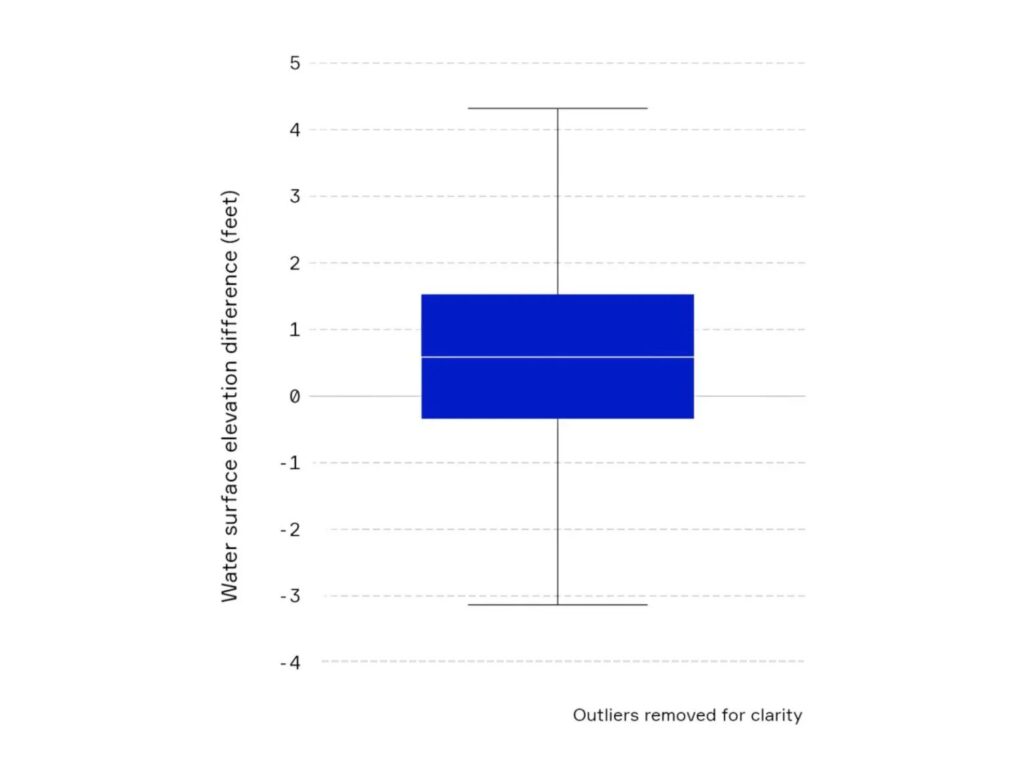
Fathom also used the differences calculated by Jones Edmunds to develop their own statistics. The box plot shows the results of Fathom’s calculations.
These showed that:
— On average, Fathom’s results were 0.6ft above the local models.
— Most of Fathom’s results were within -0.35 to + 1.55ft of the local models.
— Nearly all of Fathom’s results were within -3.15ft to +4.35ft.
Building confidence in flood risk assessment
Across the 43,000 points analyzed across the state of Florida, Fathom’s model compared closely to the detailed local flood models.
This gave our partners and client confidence that Fathom’s data was suitable for the project. The vulnerability assessment went ahead using FEMA and other public data along with Fathom’s US Flood Map and bespoke data to assess flood vulnerability across the state.
Interested in how Fathom’s data can support your next engineering project? Learn more here or book a call with a member of our engineering team. We’re always excited to learn more about use cases for Fathom data on the ground.
Discover how Fathom supported the Florida Department of Environmental Protection to create a statewide flood vulnerability assessment for critical assets
Quote Fathom provides a much-improved resolution of flood risk mapping. This helped us identify significantly more critical assets that were at risk compared to that shown using FEMA maps and created a more localized understanding of flood risk.
