Engineering climate resilience into the UK rail network
Fathom’s climate-conditioned data provided the consistent and detailed view of risk that was crucial to Network Rail’s climate adaptation strategy
Assessing flood risk consistently across the UK’s national rail network
Network Rail is an arms-length body of the Department of Transport that owns, operates and develops the railway infrastructure of England, Scotland and Wales. It looks after 20,000 miles of track, 30,000 bridges, viaducts and tunnels, thousands of signals and level crossings, and owns over 2,500 stations, managing 20 of the busiest and biggest. Every year the network carries 1.8bn passengers and 69m tonnes of freight, making it the backbone of the nation’s critical infrastructure.
The impacts of weather events are keenly felt on this rail infrastructure. Heavy rainfall, flooding and landslides cause damage and block lines leading to delays, safety risks and costly repairs. As extreme weather events become more severe and frequent due to climate change, the risk to these rail assets increases.
Network Rail’s Weather Resilience and Climate Change Adaptation (WRCCA) strategy was set up to address this growing risk and build more climate resilience into the network. The WRCCA team worked with engineering consultancies Arup and Jacobs, using Fathom’s data to better understand the present and future flood risk to their assets along the entire network.
Right: A map of Great Britain identifying the data provided to cover Network Rail’s network

Providing consistent, nationwide flood risk data
First was an R&D exercise with Arup to develop a consistent approach and methodology for assessing climate risk to generate hazard indicator maps of the rail network. The aim was to develop the outline technology architecture and design specification for the WRCCA Mapping Application prototype. One of the hazards Network Rail wanted to map was flood, and for this they needed consistent, accessible flood data across England, Wales and Scotland.
Open source data was available from three different agencies – the Environmental Agency (EA) in England, the Scottish Environmental Protection Agency (SEPA) and National Resources Wales (NRW). However, each had different flood modeling methodologies and not all provided the future view of flood risk due to climate change. This meant there was no consistent data across the different countries that included climate scenarios and future time frames.
Fathom was brought on board to fill the gaps and provide the required flood data across three types of flooding, including bespoke climate scenarios and return periods. This was fed into the Network Rail methodology and transformed, along with other climate hazard data, into a series of hazard indicators.
The Fathom UK dataset included:
- UK defended and undefended flood hazard maps
- Separate pluvial, fluvial and coastal flood layers
- 11 return periods instead of the standard 10
- Custom climate scenario RCP 6.0 as well as the standard RCP 8.5 at the 50% percentile
- Four time horizons: current, 2030, 2050 and 2070
This data was imported into Network Rail’s systems and overlaid with asset data, allowing Network Rail to create flood hazard layers that cover the network and a 1 km buffer on either side, which gives a consistent view of present and future flood risk.


Creating more granular asset risk data
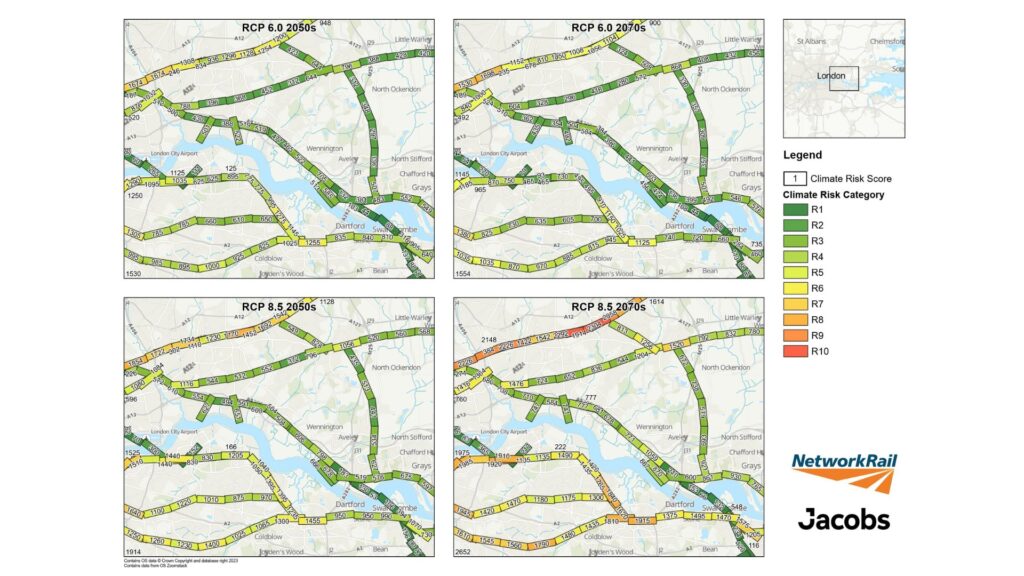
The next project with Jacobs moved from methodology and hazard-mapping into generating risk scores for each of Network Rail’s assets, everything from points to tunnels and signal equipment to bridges. This combined the data from the first project with a Jacobs-developed risk-scoring methodology using a 2km x 500m grid for the whole network.
This granular information would enable Network Rail to assess not only where the risk is but also what is driving that risk, which assets are at risk, and the severity of the risk to each asset.
Fathom’s data was layered over asset data, allowing the team to build a tool that shows the risk of every asset within each cell of the grid, assessed against climate data. The overlapping of this data enabled the team to create a set of risk scores/grading to help identify the areas in need of improvement.


Risk Scores
Powerful flood risk metrics for any global location, under any climate scenario
Enhancing UK rail’s resilience against future climate risks
Using Fathom’s data and a methodology developed by Arup and Jacobs, Network Rail is coming closer to its goal of building an asset-based risk-mapping tool that shows where risk lies, which assets are at risk, and to which degree.
This tool will be used internally to inform key decisions on where to prioritize asset strategies and investment, as Network Rail sets out its climate adaptation pathways.
Ultimately the project will help the organization form long-term action plans to develop a safer, better performing and more resilient rail network, long into the future.

Quote Fathom’s data enabled us to strategically understand the overall risk across the network, both now and in the future. Having a consistent view of flood risk across countries allows us to make key data-driven decisions, based on comparable data.
Read Case Study
Quote Using Fathom’s data meant Network Rail could quickly access geospatial data for just the locations they needed along their network, for both present day and future scenarios, and that’s consistent across the whole of Great Britain.
Quote Fathom’s data gave a unified approach for analyzing risk in all regions – we had certainty that we were comparing like with like. It also had the benefit of giving us consistent future climate layers, which we couldn’t get from a publicly available source in a unified fashion across Great Britain.
Read Case Study