-

-
-
Green, J.,
-
-



With academic research at our core, Fathom is committed to advancing the world’s understanding of flooding. Here, we introduce three of the next-generation flood scientists we are currently sponsoring.
Commitment to academic research is one of Fathom’s core principles. Founded in 2012 by researchers at the University of Bristol, Fathom now has a growing team of hydrologists, climate scientists and flood modelers who have contributed to more than 60 (and counting) papers published in industry-leading peer-reviewed science journals. We have forged connections with organizations around the world, from universities to CNES and the UK Space Agency. And we have a history of supporting the next generation of scientists, in the form of PhD sponsorship. The benefits of this, for Fathom as a business, the industry as a whole and the researchers themselves, are numerous.
A win-win for researchers, Fathom and the industry
Why are we doing this? First, this is a great way to invest in our own staff. The three researchers we’re currently sponsoring (see below) have all previously worked for Fathom. They now have access to the support and resources only a business can provide, as well as the freedom to pursue their academic interests.
Secondly, as risk modeling professionals, we know where the limitations of flood models are and we are keen to support research that helps reduce uncertainties and progress flood science in general.
This research will ultimately feed directly into Fathom’s products and projects, too, so it’s a way not only to advance flood science but also ensure we have the expertise to develop it into market-leading products.
Meet three Fathom-sponsored PhD researchers:
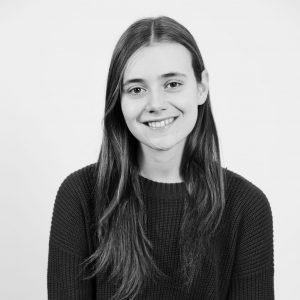
Izzy Probyn
University of Bristol
PhD in advancing large-scale flood modeling with the surface water and ocean topography (SWOT) mission
After three years at Fathom focusing mainly on stochastic modeling, Izzy is now several months into a PhD hosted by University of Bristol. Her research is aimed at advancing global flood models using data from the NASA-led Surface Water and Oceanic Topography (SWOT) satellite mission.
This feeds into a project with the UK Space Agency, looking at how we can use SWOT data to improve flood model parameterization. Parameters are the variables that influence flood behavior, such as elevation, soil moisture and river discharge (the volume of water flowing through a river at a given point in time). Fine-tuning these parameters is crucial for creating a realistic simulation of flooding.
Izzy is developing a river discharge algorithm using SWOT’s water elevation data. “SWOT’s elevation data is very, very good,” explains Izzy, “but the width data is very noisy, which presents challenges to determining discharge currently.” She is taking a regionalization approach that will allow us to more accurately calculate the river discharge, almost like a virtual gauging station. It’s a cutting-edge approach that could one day be used in Fathom’s models.
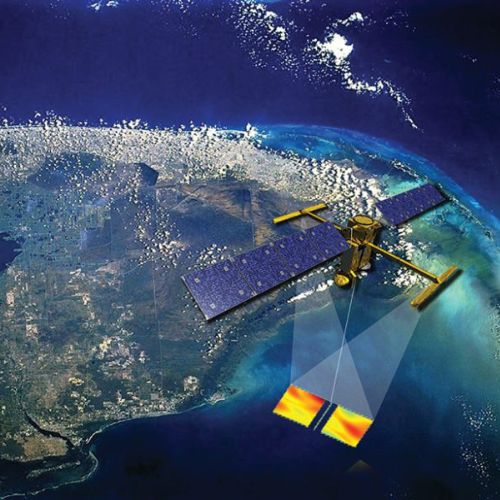
SWOT: The game-changing satellite mission
SWOT (Surface Water and Oceanic Topography) is a NASA-led satellite mission that collects measurements of all the water on the planet’s surface every 21 days. It has the potential to change our understanding of the water cycle and could improve the way we model floods.
How is Fathom involved?
Fathom has been involved with SWOT from its conception. Our Chairman, Professor Paul Bates, is one of the mission’s lead scientists and Dr Stephen Chuter is the Fathom project lead on a collaboration with Bristol University and the UK Space Agency to work out how SWOT data can be used to build better flood models.
Hamish Wilkinson
University of Bristol
PhD in global storm surge modeling under diverse climate scenarios and modes
Hamish worked at Fathom developing tropical cyclone modeling frameworks before he embarked on his PhD on the emulation of dynamic storm surge models.
His research builds on the work he was doing at Fathom, which involved using dynamic numerical models to simulate coastal flooding. “I’m now looking at ways to train an AI model that can learn from these dynamic simulations and run much more quickly – and cheaply,” explains Hamish.
This feeds heavily into Fathom’s plans for coastal flood modeling. “The dream is to move away from statistical estimates of boundary conditions and to provide large ensembles of actual event footprints,” says Dr Niall Quinn, Fathom’s Chief Technical Officer and one of Hamish’s PhD supervisors. “One way to do that is by building physical models that simulate flooding events, but that is incredibly expensive. So the goal is to find a way to produce high-quality outputs at a fraction of the computational cost.”
Another part of the research is looking at ways to estimate important inputs, such as bathymetry, into flood models in regions where data is scarce. “These two elements are going to be a huge amount of work,” says Niall, “but the research really underpins where we want to go at Fathom.”
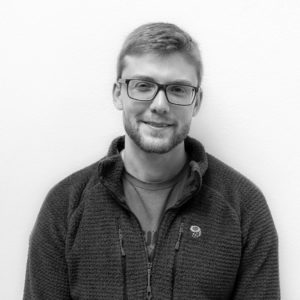

Joshua Green
University of Bristol and University of Southampton
PhD in compound flooding
Joshua has a BSc in Geographical Sciences from the University of British Columbia and worked for various Canadian and US environmental government agencies before joining Fathom remotely as part of the coastal team.
His PhD research focuses on compound flooding from Tropical Cyclones – an important area of research for Fathom. River, coastal and rainfall-driven flooding are usually simulated independently, yet the complex interactions between these drivers can affect the accuracy of flood estimates and thus risk. The ultimate goal of his research is to bring Fathom’s coastal, precipitation and river discharge data together to create a compound flood modeling framework, which will then feed back into Fathom’s products.
“I have quite a broad background in Earth sciences and geography, and doing a PhD is an introduction to a specialization – you’re sowing the seeds for future opportunities,” says Joshua.
“Having a connection to a tech company like Fathom means you have access to more data, computational resources, and expertise than you would typically have in a purely academic environment. This allows me to focus on innovative approaches, and pursue research with meaningful and exciting applications.”
Collaborating for the future of flood science
The PhD projects Fathom is sponsoring have all been made possible through collaboration. Two of them were funded through the FLOOD-CDT, the Centre for Doctoral Training for Resilient Flood Futures, which was set up by the National Environment Research Council (NERC) and brings together universities, research centres and commercial businesses. The aim is to support flood scientists who translate research into real-life practice, bolstering the UK’s expertise in flooding.
Building these collaborations is just one of the benefits of doing, and sponsoring, a PhD. And, as Dr Stephen Chuter, Fathom’s Senior Scientific Developer and PhD supervisor, points out, it is part of Fathom’s long-term strategy. “A PhD is an opportunity not just for the researcher but also the company to pioneer long term research avenues that could be the next big thing in flood modeling. We are investing in what will be the cutting edge in the future.”