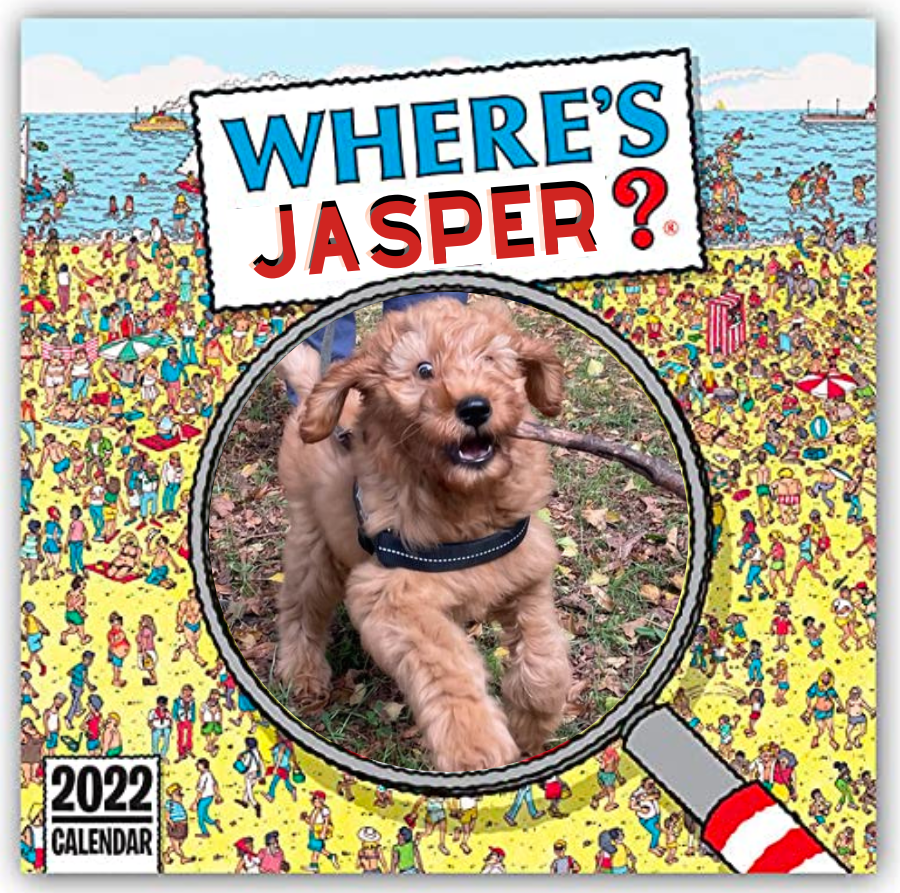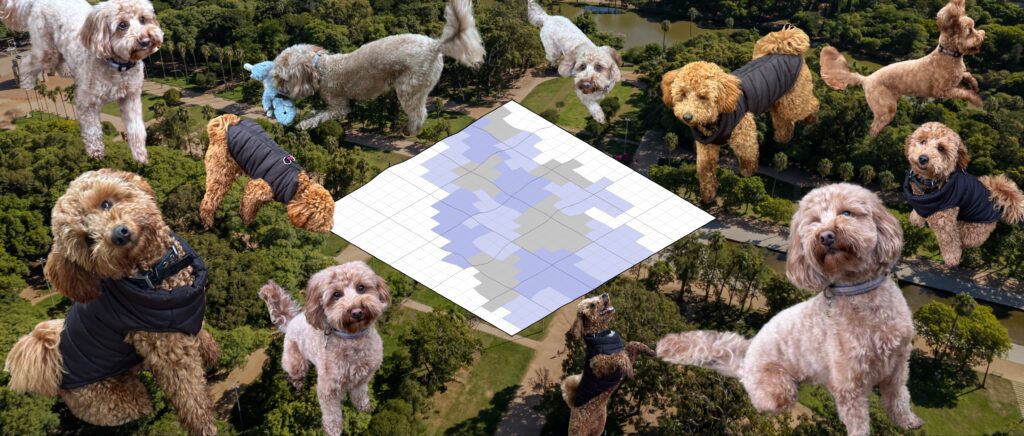



Fathom’s office dogs not only provide stress relief and entertainment to the staff; they also feature occasionally in our articles and talks. Dr Oliver Wing’s giant double-doodle, Jasper, was particularly helpful as an illustrative aid during his Instech seminar on climate change and variability. This time, he ropes in a couple of fictional poodles, Monte and Carlo, to talk about our newly launched flood catastrophe model and how probabilistic modeling helps us understand risk and uncertainty.
A flood cat model is designed to inject some stability into the estimation of very rare flood events, many of which may never have been observed. We simply haven’t been taking enough measurements of the Earth for long enough to understand extreme possibilities solely through interpreting historical data.
Real history – what actually happened – only represents one possible outcome of the underlying risk. To truly understand this risk, we need to move beyond the single version of recorded history available and consider all the imagined histories that could have happened instead.
This is what a cat model does. It fills in the probability distribution left threadbare by our limited historical data. Using statistics and physics to simulate millions of plausible flood events, a cat model synthetically extends the historical record to be ~100 times longer than it was in reality.
This ‘event set’ – spanning many millennia, rather than a few decades – is then used to assess the potential financial impact of extremes. If we need to understand the loss which might have a 0.5% annual chance of being exceeded (commonly called the 200-year loss), we get a very unstable estimate with only, say, 40 years of data. But with 10,000 years of data, it’s a walk in the park: just find the 50th most damaging year in the event set.
Meet the four-legged agents of chaos
So how does that relate to poodles? Let’s unleash the hounds.
Meet Monte and Carlo.
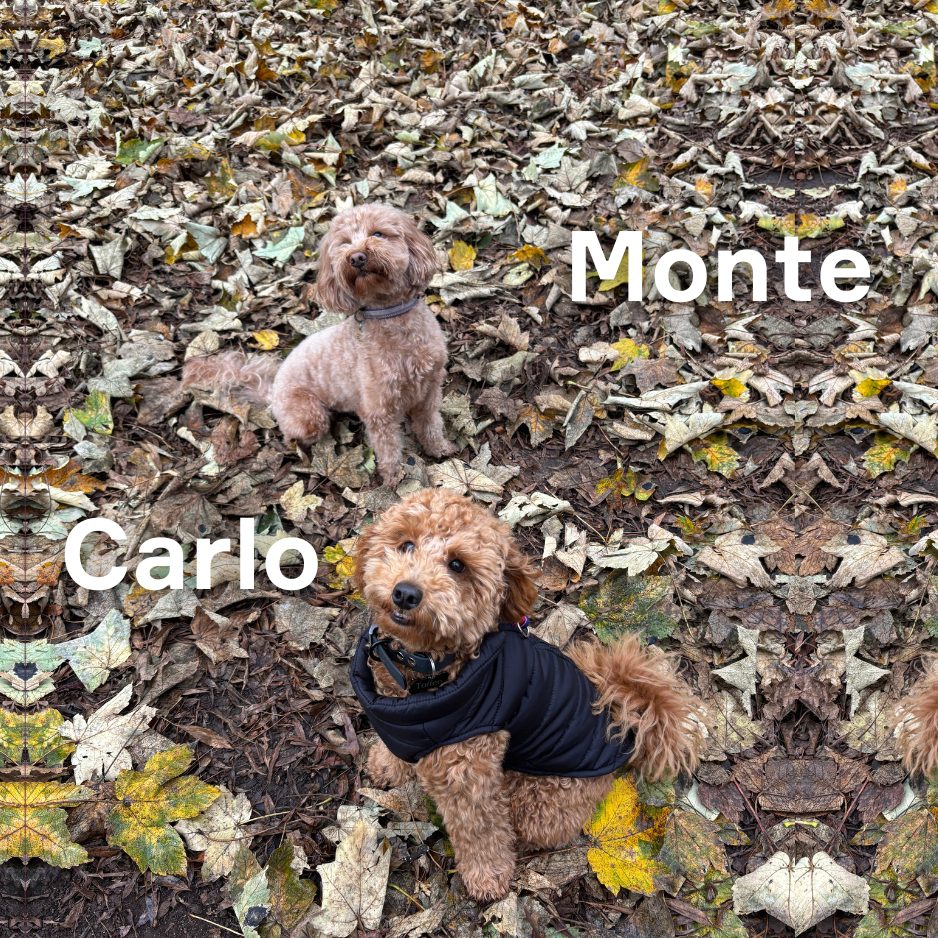
Monte
Will be your friend if you have a ball. Constantly confused why humans interrupt her nap time.
Carlo
Lover of walks, fellow dog friends and chew toys. Hater of hoovers, cardboard boxes and being told it’s not play time.
Monte and Carlo enjoy a walk in their local park and have been doing so once a week for a year. They love to terrorize the local squirrel population, but haven’t managed to catch one yet. Their owner, Markov, for want of a more meaningful hobby, wants to know what the chances are of Monte or Carlo catching a squirrel.
Monte and Carlo always enter and exit through the same gate with Markov in Lorenz Park. Other than that, what happens is entirely unpredictable. One week the poodles might sniff around in the bushes, the next they head straight for the duck pond. It might be raining, so they roll around in the mud. Or it might be hot and sunny, so they play in the shade. A discarded kebab might look attractive, or that very specific stick over there might be just the thing they’re looking for.
We have 52 observations of what Monte and Carlo get up to in the park, but it’s difficult to predict what they might get up to in any given week. And we certainly haven’t seen them do anything as extreme as catching a squirrel.
Random walks (literally)
Markov’s a smart guy. He knows that just because Monte or Carlo haven’t caught a squirrel in the short period for which he has observations that it couldn’t happen at all. He needs more data.
Luckily Markov has a good mate called Dolly. Dolly happens to be a cloner. She clones the poodles, unleashing 10,000 Montes and Carlos on Lorenz Park. Markov has plenty of time on his hands, so he walks each Monte and Carlo pair independently every week over the course of the following year.
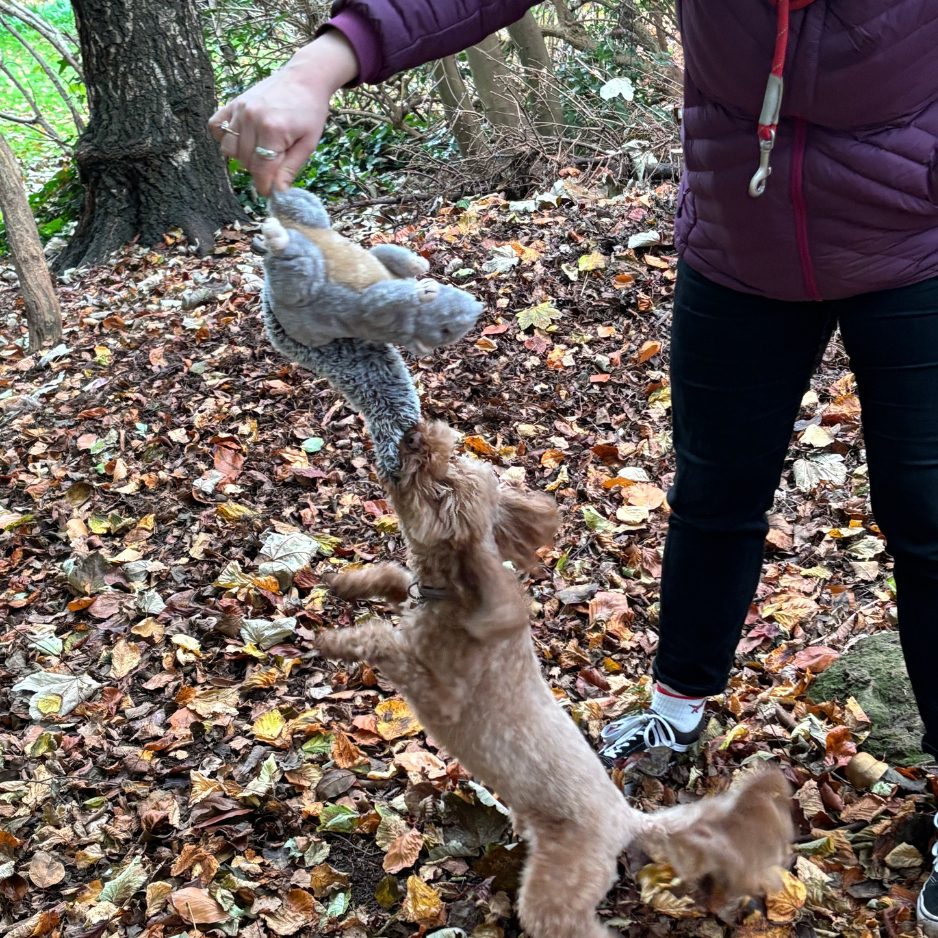
The squirrel death toll is catastrophic: 200. Markov realizes that he was misled by his first year of Monte and Carlo dog walks. In the 10,000 years of equivalent dog walks that followed, he learns that there’s a 2% annual chance (1 in every 50 years) that his poodles catch a squirrel.
Exhausted from his ensemble of relentless dog walks, Markov decides a walk in Lorenz Park is just too risky. Perhaps squirrel-free and dog-friendly Charney Beach would be a better bet.
It’s raining cats and dogs
So what does this have to do with flood cat modeling?
We’ve seen some catastrophic flood events in recent history, but not enough to understand how likely they are to happen again – or if even bigger ones are possible. Markov knew he needed more observations of his poodles, but he didn’t have the patience (or life expectancy) to gather enough data from the original Monte and Carlo to understand squirrel-related risks.
We’re impatient at Fathom too. We aren’t going to sit and wait for the next flood disaster like immortal sentinels standing watch, only to conclude in the year 12024 AD that we now finally understand the risk. We also don’t want to get mired in the ethics of dog cloning.
So what we built instead was a flood event set. Taking what available information we have on past flood events, we filled out the patchy probability distribution of possible flood events with a stochastic model – harnessing the power of randomness and big numbers similar to Markov’s chain of dog clone walks.
We also adjust these events based on how different the climate is now to when those events took place (imagine Markov only walked his clones when it was warmer than average).
With very complicated laws of physics (water flows downhill) and very complicated data (where downhill is), we can understand what happens locally during these imaginary flood events and build up a more complete picture of the risk.
That’s what Global Flood Cat does: correlated flood risk, anywhere in the world. And we can only do it with a synthetic event set. As Markov learned the hard way – broken in both body and spirit as he prised the 200th squirrel carcass from Carlo’s jaws – a lack of precedent does not preclude a lack of foresight.
Learn more about Fathom’s Global Flood Cat, the first global catastrophe model to include all major flood perils: pluvial, fluvial and coastal.