
Insurance stress tests for the Bank of England’s PRA
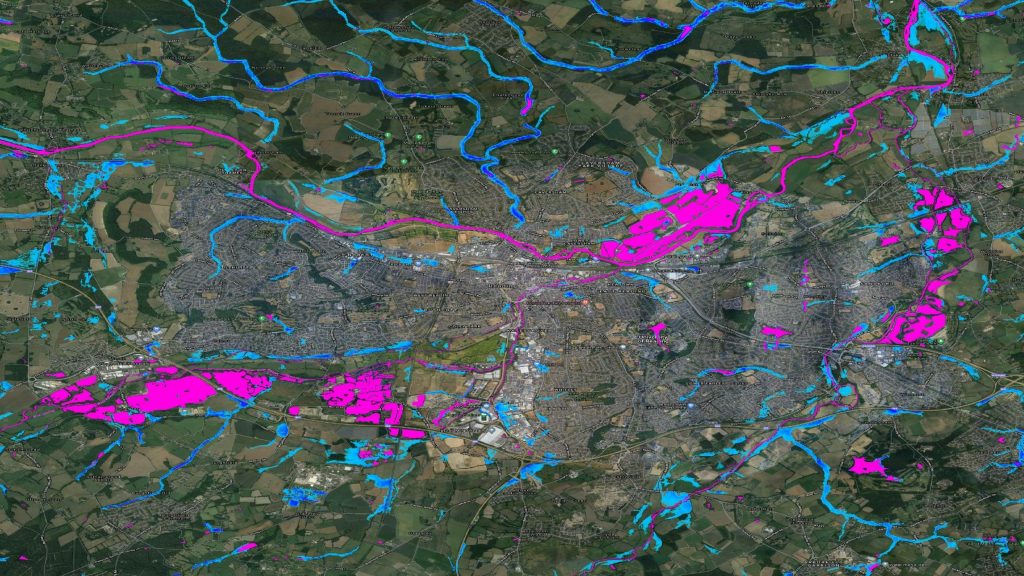
AXA chose to use Fathom’s flood event footprints in a major regulatory reporting exercise.
The challenge: Rising climate risks for insurers
Climate change is placing growing pressure on the financial resilience of the insurance sector. As flooding and other natural hazards increase in number and severity, so do potential losses incurred by insurance companies.
In 2022, the regulatory arm of the UK’s central bank, the Prudential Regulatory Authority (PRA), required major general insurers to assess their resilience to natural disasters. The request came as part of the PRA’s biennial insurance stress test (IST).
This was the first time that the PRA had included climate risks in this regulatory exercise for the UK’s largest insurers. Alongside hurricanes and earthquakes in the US, and cyber underwriting risks, the IST 2022 required insurers to stress test against windstorm and flood in the UK.
The PRA specified three precise windstorm and flood scenarios to test against. Further, they provided a short list of vendors who supply event footprints for insurers to use in their tests. (See pages 27-33 of the PRA’s guidelines for scenario descriptions and lists of flood map vendors).
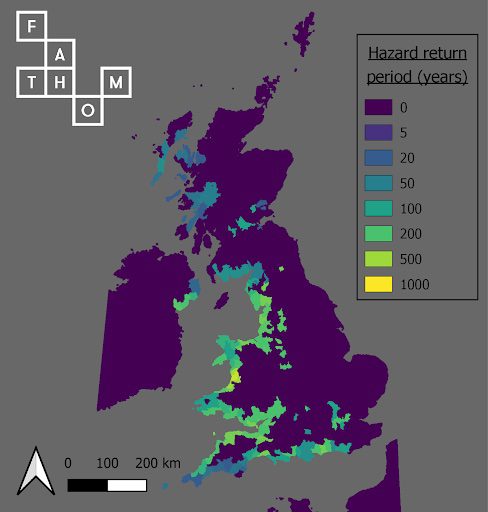
The PRA listed Fathom as one of five providers of event footprints for two of the three windstorm and flood scenarios; the scenarios being:
- a major storm surge along the west coast of the UK
- an extensive 4-week inland flood
AXA was one of the 17 general insurers who completed the IST and needed to select a provider of these footprints.
Understand more about how Fathom’s data support insurers to rapidly analyze and price exposures across the globe.
The solution: Fathom’s event footprints power AXA’s submission
AXA chose Fathom’s event footprints for the UK storm surge and inland flood scenarios.
At the time, AXA and Fathom were working together to build a new European cat model for AXA. AXA was, therefore, already highly familiar with the scientific calibre and transparency of Fathom’s products, which are a direct result of Fathom’s extensive catalogue of peer-reviewed academic research, produced in collaboration with academic institutions.
“As we were already working with Fathom on the European cat model, it felt natural to get back to them to test the footprints for the IST,” explains Remi Meynadier, AXA’s Climate Analytics and Research Leader. “Our ambition is to be as close as possible to the academic world so that we can quantify risk as accurately as possible.”
Fathom supplied AXA with the two event footprints. It extracted these from Fathom-UK CAT, its comprehensive cat model for the UK.
For full transparency, it also supplied AXA with the raw data behind the footprints. These revealed water depths across all locations in the maps.

Quote The transparency of Fathom’s data is very important to AXA. Not only does it help us understand risk very precisely, so that we can better assess and manage it, it also adds value to our regulatory reporting because it allows us to explain the story behind losses.
The results: Transparent data strengthens regulatory reporting
The footprints’ transparency and scientific rigor strengthened AXA’s IST submission to the PRA. “Fathom’s view of the stress events was really helpful because it added value to our explanations,” says Hugo Rakotoarimanga, a research engineer for AXA who supported the submission.
After running the footprints through its model, AXA was able to explain the outputs to the PRA comprehensively, thanks to the raw data provided by Fathom. “We could show exactly which regions were responsible for most of the losses,” Meynadier adds.
The PRA published the main results of the IST 2022 in January 2023. These indicated that: “the UK insurance sector is resilient to the scenarios, subject to a number of mitigating measures.”
Get in touch
Get in touch to find out how Fathom’s climate-risk data will strengthen your regulatory reporting:
Related case studies

AXA: a cutting-edge catastrophe model for Europe
Learn how Fathom and AXA built a state-of-the-art catastrophe model that strengthens AXA’s financial resilience and regulatory reporting.

Arup & World Bank
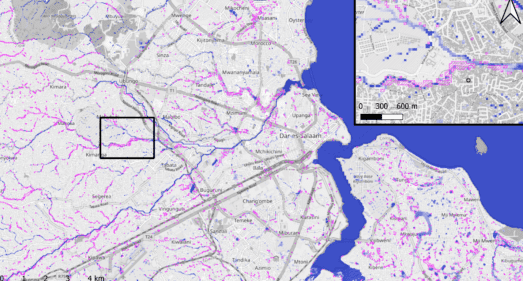
Fathom & Arup demonstrate how rapid, data-driven flood modeling can quantify the impact of urban greening on flood extent, soil erosion, and urban heat. Discover how NBS can create more resilient cities.

Texas Water Development Board
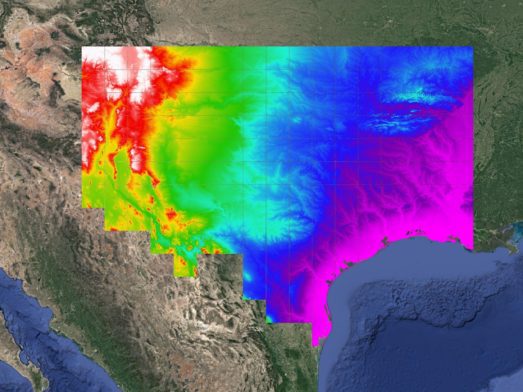
Texas Water Development Board uses Fathom data, and others, to accelerate the development of the first statewide flood planning program in the absence of publicly available flood data.

FEMA’s Risk Rating 2.0
Fathom provided FEMA with a more accurate, up-to-date picture of US flood risk which informed how the NFIP prices insurance, using Fathom-US flood map.