


Scientists urged to ‘pull the plug’ on bathtub modeling
Recent decades have seen a rapid surge in damages and disruptions caused by flooding. Never has the importance of accurately predicting flooding been so important to inform policy and build adaptation strategies for communities.
A new commentary by leading flood researchers calls for an end to the use of ‘bathtub’ modeling—the assumption that floods spread out as a level pool—which represents an oversimplification of flooding. Led by Dr Brett Sanders, Chancellor’s Professor from the University of California Irvine, and co-authored by Dr Oliver Wing, Chief Scientific Officer at Fathom and Dr Paul Bates, Chairman at Fathom and Professor of Hydrology at the University of Bristol, the commentary examines the biases and uncertainties found in ‘bathtub’ modeling, reviews previously published research studies that rely on this oversimplification, and highlights the dangers of employing such a method with respect to risk management and climate adaptation.
What is a bathtub model?
Bathtub modeling is a flood simulation technique that projects a flood surface onto a digital elevation model (DEM). It assumes the water rises uniformly over an area, like filling a bathtub, and ignores complex factors such as flow pathways, drainage systems and the physics of water movement. Often used as a straightforward way to visualize flood impact in coastal areas, it can provide an oversimplified and less realistic picture of flood risk than more advanced flood models, unable to obey basic physical laws. The alternative to bathtub models is dynamical models that solve physics-based equations.
Limitations of bathtub modeling
According to Professor Brett Sanders from the University of California Irvine:
“Bathtub models can both overpredict and underpredict flooding. One the biggest causes of error is that bathtub models fail to accurately account for the systems in place to protect people and assets including storm drain systems, levees and pumping.”
Sanders, Wing and Bates provide the diagram below illustrating numerous flooding mechanisms that aren’t captured by bathtub models.
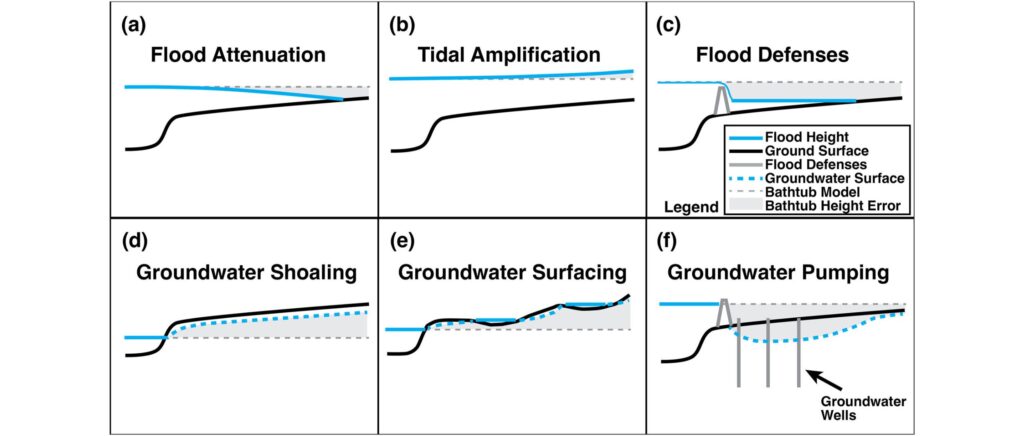
Figure 1 from Sanders, Wing and Bates (2024) shows the limitations of bathtub modeling include the inability to capture:
- Flood attenuation from the effects of event dynamics and friction on flood spreading
- Tidal amplification associated with the resonance of ocean tides within coastal embayments
- Flood defenses such as levees and floodwalls that may overtop during an extreme event but still restrain the degree of inland flooding
- Shoaling of the groundwater table
- Surfacing groundwater from the combined influence of rising sea levels and changing hydrologic budgets
- Pumping of groundwater within lands below sea level to mitigate inundation by rising groundwater.
Based on a review of literature, the research team summarized the limited accuracy of bathtub models using a measure known as the Critical Success Index (CSI), which scores flood extent accuracy between 0 and 1, where 1 represents a perfect match based on field measurements. The CSI for the bathtub models analyzed in the literature consistently have a CSI under 0.5, well below the threshold of 0.65 suggested by Fleischmann et al. (2019) for models that start to have local relevance, and therefore produces useful and usable results when applied in impact analyses.
Dr Oliver Wing, Chief Scientific Officer at Fathom, explains:
“CSIs under 0.5 indicate these models are worse than a random classification. In other words, a chimpanzee has more skill than a bathtub model in delineating flood hazards areas.”
The dangers of relying on bathtub modeling
Studies that rely on bathtub modeling are frequently found in short-format, high-impact journal
publications, which attract considerable interest from news media. And while bias and uncertainties from bathtub modeling are often acknowledged in these technical papers, the message communicated to the public and policy makers—sometimes with compelling visualizations of cities under water—is too often an exaggeration.
Professor Paul Bates, Chairman at Fathom, commented:
“Accurate maps of areas at risk of flooding are of paramount importance for everyone from home and business owners to insurers, banks and governments. We all have a role to play in reducing flood losses, but it all starts with trustworthy information”.
Crucially, accurate and trusted models of flood risk are needed to effectively engage impacted communities in adaptation processes and to implement effective and equitable mitigation and adaptation strategies. Inaccurate models could also lead to maladaptation.
“Projections of flooding need to make sense to people, not only for building understanding of what’s a risk, but deciding upon the investments and policies that will be made to manage it”
said lead author Dr Brett Sanders. In fact, numerous research papers have shown that residents within at-risk areas are unlikely to trust projections of future flooding if they don’t reflect their lived experiences. In short, research studies that oversimplify flooding and don’t represent real-world data pose a threat to transformative action.
A call for change
The solution? Researchers Sanders, Wing and Bates urge scientists, journal editors and reviewers to prioritize credibility of flood science and pull the plug on bathtub modeling. The paper highlights several methods and sources of data available today that can be used as an alternative to bathtub modeling.
Instead of bathtub modeling, Fathom relies on dynamical models that solve physics-based equations. Check out the research paper underpinning our Global Flood Map, which includes CSI scores that demonstrate our unprecedented levels of fidelity for a global flood map.
Following its publication, this commentary gained media attention from the likes of: